
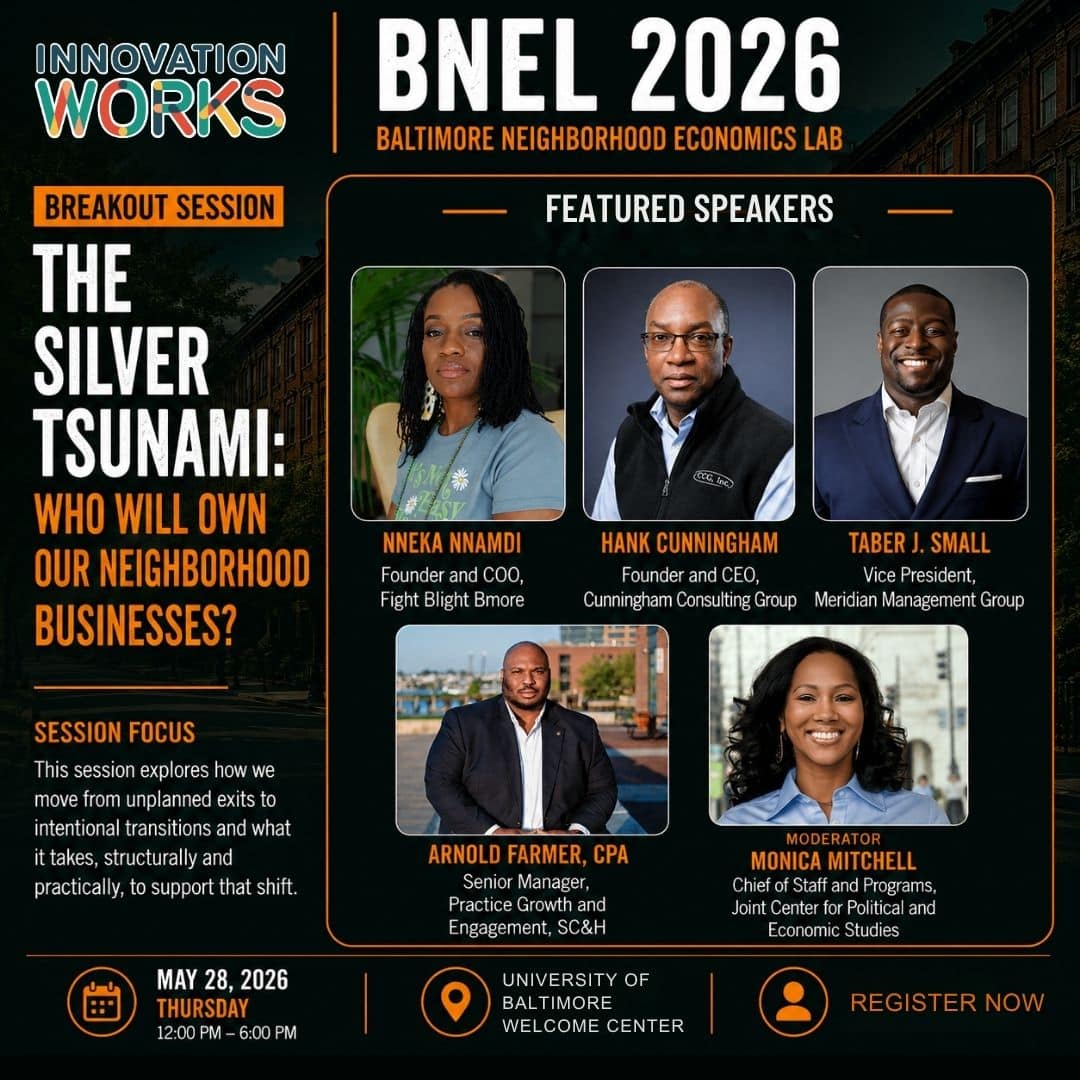
The Silver Tsunami: Who Will Own Our Neighborhood Businesses?
Many neighborhood businesses are led by owners who are nearing retirement or preparing for transition. When those businesses close without a succession plan, communities can lose more than a storefront. They can lose jobs, trusted relationships, commercial activity, and long-standing neighborhood anchors.
This session explores what happens when legacy businesses disappear and what systems, capital, and advisory supports are needed to preserve ownership, strengthen corridors, and support successful transitions.
Featured Speakers
Monica Mitchell
Chief of Staff and Programs, Joint Center for Political and Economic Studies
Nneka Nnamdi
Founder, Fight Blight Bmore
Hank Cunningham
CEO, The Cunningham Consulting Group, Inc
Taber J. Small
Vice President, Meridian Management Group
Arnold Farmer, CPA
Senior Manager, Practice Growth and Engagement, SC&H
What to Expect
The session will begin with a welcome and framing conversation on why succession planning matters to neighborhood economies. Participants will be introduced to the Succession Wall and invited to contribute throughout the session.
Grounding Perspectives
Grounding perspectives from Monica Mitchell and Nneka Nnamdi will connect national succession trends, aging ownership realities, corridor decline, vacancy, and ownership continuity.
Succession Wall
During the session, participants will contribute to the Succession Wall using the prompt:
“What happens when legacy businesses disappear?”
Participants will reflect on what businesses are hardest to replace, what makes succession difficult, what support is missing, and what keeps legacy businesses alive.
Panel Discussion
The panel discussion will explore succession planning realities, exit readiness, family transition, capital and advisory gaps, and ownership preservation.
Live Reflection
During the panel discussion, reflections and themes emerging from the Succession Wall will periodically be woven into the conversation, helping connect participant insights back to the broader discussion.
Closing Reflection
The session will close by surfacing key themes from the Succession Wall and identifying what Baltimore neighborhoods need to better preserve legacy businesses, support transitions, and keep ownership rooted in community.